Level 1 - Lesson 7
This lesson follows a student who prepares in a company Chinese class and then uses that Chinese with Doctor Hu. The student reads and writes Chinese first, then answers Doctor Hu's question about speaking Chinese.
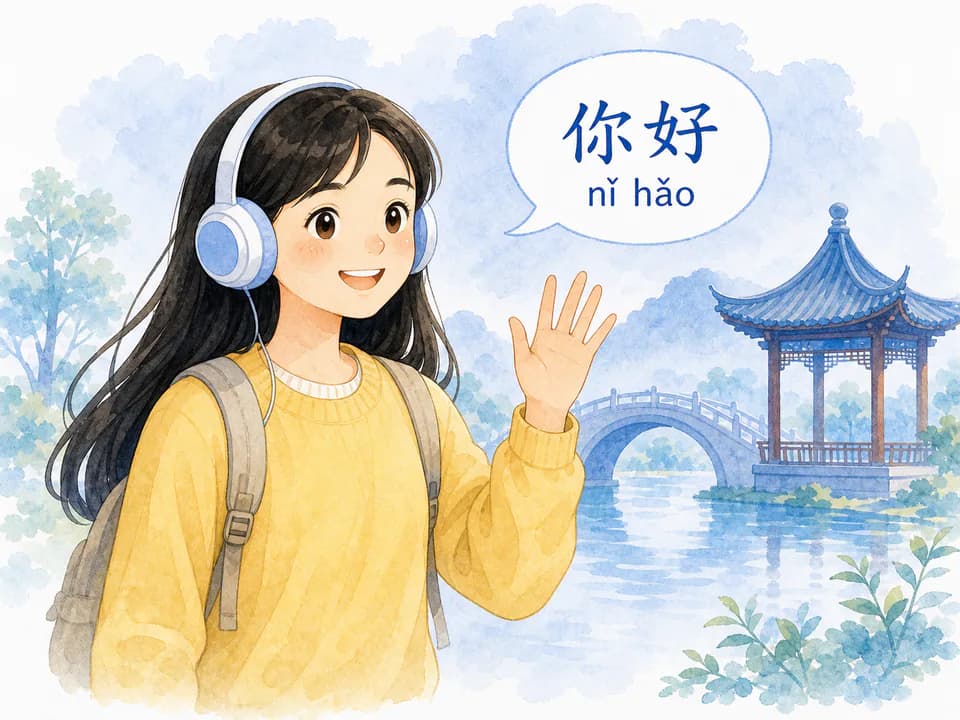
Contains 4 words
to read
to read; to study
book
class; lesson
Contains 4 words
Contains 6 words
Contains 4 words
你有中文课吗?
Nǐ yǒu Zhōngwén kè ma?
Do you have Chinese class?
公司有中文课。
Gōngsī yǒu Zhōngwén kè.
The company has Chinese class.
我读书,写汉字。
Wǒ dú shū, xiě Hànzì.
I study and write Chinese characters.
我们读中文。
Wǒmen dú Zhōngwén.
We read Chinese.
胡医生,你好。
Hú yīshēng, nǐ hǎo.
Hello, Doctor Hu.
Situation: Two classmates establish that one has Chinese class and what she can write.
美美
Meimei
你有中文课吗?
Do you have Chinese class?
Modal verbs
Use 会 (huì) before an action to say someone has learned how to do it.
Person plus 会 (huì) plus action
Says what someone has learned how to do.
to write
Chinese character
character; written word
Chinese language; written Chinese
work; to work
company
matter; thing to do
doctor
hospital
Doctor Hu
can; know how to
to speak; to say
to speak; to talk
a little bit
很好。你会说中文吗?
Hěn hǎo. Nǐ huì shuō Zhōngwén ma?
Very good. Can you speak Chinese?
你会说中文吗?
Nǐ huì shuō Zhōngwén ma?
Can you speak Chinese?
我会说一点儿中文。
Wǒ huì shuō yìdiǎnr Zhōngwén.
I can speak a little Chinese.
我们说中文。
Wǒmen shuō Zhōngwén.
Let's speak Chinese.
方方
Fangfang
有,我有中文课。
Yes, I have Chinese class.
美美
Meimei
你会写汉字吗?
Can you write Chinese characters?
方方
Fangfang
会,我会写一点儿汉字。
Yes, I can write a few Chinese characters.
Situation: Two classmates check reading ability and decide to read a Chinese book together.
美美
Meimei
你会读汉字吗?
Can you read Chinese characters?
方方
Fangfang
会,我会读一点儿。
Yes, I can read a little.
美美
Meimei
我们读中文书,好吗?
Shall we read a Chinese book?
方方
Fangfang
好,我们读书。
Okay, let's read.
Situation: A student confirms both a doctor's identity and the specific hospital affiliation needed.
美美
Meimei
你是胡医生吗?
Are you Doctor Hu?
胡医生
Doctor Hu
是,我是胡医生。
Yes, I am Doctor Hu.
美美
Meimei
你是北京医院的医生吗?
Are you a doctor at Beijing Hospital?
胡医生
Doctor Hu
是,我是北京医院的医生。
Yes, I am a doctor at Beijing Hospital.
Situation: Two classmates check whether one is free, then decide to talk in Chinese.
美美
Meimei
你有事吗?
Do you have something to do?
方方
Fangfang
没事。
No, I am free.
美美
Meimei
我们说一点儿中文,好吗?
Shall we speak a little Chinese?
方方
Fangfang
好,我们说中文。
Okay, let's speak Chinese.
我会说一点儿中文 (wǒ huì shuō yìdiǎnr Zhōngwén) and 我会写汉字 (wǒ huì xiě Hànzì) place two different learned actions after 会 (huì).
Use 会 (huì) before the speaking action, then add 吗 (ma) for the question.
你会说中文吗?
Can you speak Chinese?
一点儿 (yìdiǎnr) makes the ability modest: a little Chinese.
我会说一点儿中文。
I can speak a little Chinese.
会 (huì) shows that writing Chinese characters is a learned ability.
我会写汉字。
I can write Chinese characters.
Without 会 (huì), the sentence reports the action but does not state learned ability.
我写汉字。
I write Chinese characters.
你会说中文吗?
Can you speak Chinese?
我会说一点儿中文。
I can speak a little Chinese.
我会写汉字。
I can write Chinese characters.
我写汉字。
I write Chinese characters.
Dialogue 02: Choosing Chinese Reading Practice, Turn 3
Ask whether someone can speak Chinese
你会说中文吗?
Can you speak Chinese?
Dialogue 02: Choosing Chinese Reading Practice, Turn 4
Answer with a little ability
我会说一点儿中文。
I can speak a little Chinese.
会 (huì) is useful for learned abilities. In this lesson, it appears before speaking actions, as in 我会说一点儿中文 (Wǒ huì shuō yìdiǎnr Zhōngwén), and it can also precede another learned action, as in 我会写汉字 (wǒ huì xiě Hànzì).
Use 会 (huì) when the ability comes from learning or practice. Compare 我写汉字 (wǒ xiě Hànzì), which simply says that I write Chinese characters, with 我会写汉字 (wǒ huì xiě Hànzì), which says I have learned how to write them. The action comes after 会 (huì), and 一点儿 (yìdiǎnr) can make the ability smaller or more modest.
Coordinating related actions with one subject
When the same person does two related actions, say the person once and place both action phrases after it.
Say the person once
Combine two related actions performed by the same person.
Both actions belong to 我 (wǒ), so the subject is understood before 写汉字 (xiě Hànzì).
The speaker does both study actions, so the second action follows directly.
我读书,写汉字。
I study and write Chinese characters.
Repeating 我 (wǒ) makes two separate statements. Combine them when they form one answer about the same activity.
我读书。我写汉字。
I read. I write Chinese characters.
我读书,写汉字。
I study and write Chinese characters.
我们读中文,写汉字。
We read Chinese and write Chinese characters.
Dialogue 01: Before Chinese Class, Turn 4
Answer with two study actions
我读书,写汉字。
I study and write Chinese characters.
Dialogue 02: Choosing Chinese Reading Practice, Turn 2
Prepare with reading and writing
有。我读书,写汉字。
Yes. I study and write Chinese characters.
The two actions in 我读书,写汉字 (wǒ dú shū, xiě Hànzì) share the subject 我 (wǒ). Chinese does not need to repeat 我 (wǒ) before 写汉字 (xiě Hànzì) because the listener already knows who performs the second action.
This lesson coordinates two study actions; it does not claim that the first action causes, enables, or gives the purpose of the second. Compare two separate statements, 我读书。我写汉字。 (Wǒ dú shū. Wǒ xiě Hànzì.), with the combined version, 我读书,写汉字。 (Wǒ dú shū, xiě Hànzì.). Use the combined form when the actions belong together in the same answer.
Why it matters
The second sentence repeats the same two related study actions.
Focus
