Level 1 - Lesson 9
This lesson adds clock time to the school language you already know. You practice half past, exact minutes, and parts of the day in short exchanges.
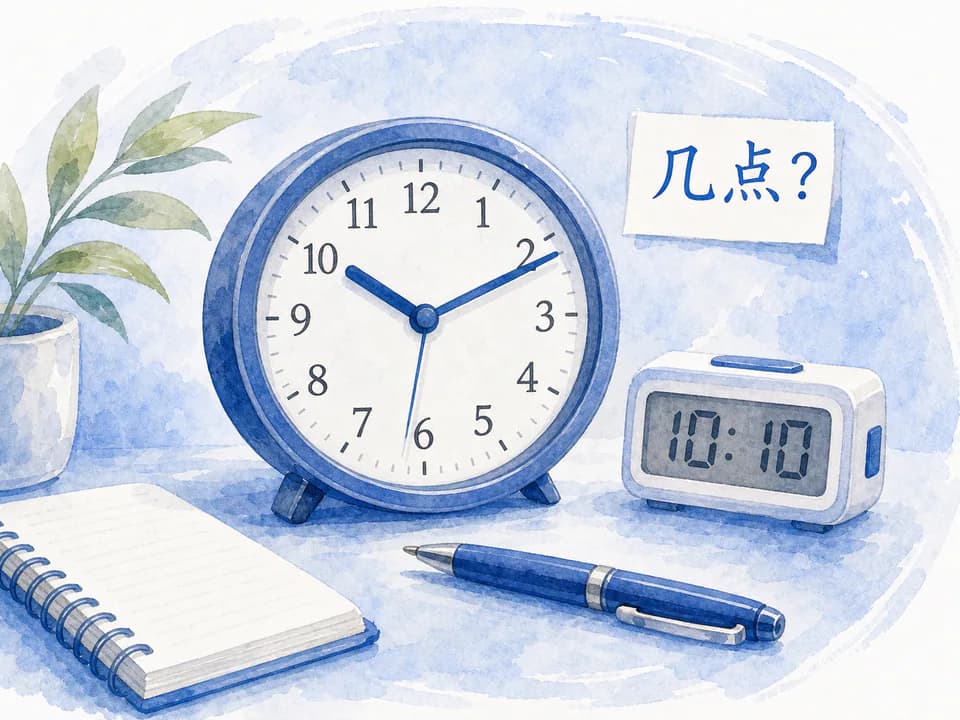
Contains 6 words
now
o'clock; point
minute
half
minute
half
Contains 3 words
Contains 2 words
Contains 8 words
现在几点?
Xiànzài jǐ diǎn?
What time is it now?
九点半
Jiǔ diǎn bàn
9:30
三点十五分
Sān diǎn shíwǔ fēn
3:15
十分钟
Shí fēnzhōng
ten minutes
十五分钟
Shíwǔ fēnzhōng
fifteen minutes
Situation: Two classmates check the current time and whether Chinese class has started.
美美
Meimei
现在几点?
What time is it now?
Time word order
Time expressions usually come before the action they describe.
Time before action
Places the time expression before the action it describes.
hour
time
time; moment
before; front
after; behind
early morning
morning
noon
afternoon
evening; night
daytime
early
late
一小时
Yì xiǎoshí
one hour
两小时
Liǎng xiǎoshí
two hours
什么时候?
Shénme shíhou?
When?
什么时间?
Shénme shíjiān?
What time?
你什么时候学汉语?
Nǐ shénme shíhou xué Hànyǔ?
When do you study Chinese?
一半时间
Yíbàn shíjiān
half the time
前一半时间
Qián yíbàn shíjiān
the first half of the time
早上八点
Zǎoshang bā diǎn
8:00 in the early morning
中午十二点
Zhōngwǔ shí'èr diǎn
12:00 noon
晚上八点
Wǎnshang bā diǎn
8:00 in the evening
很早
Hěn zǎo
very early
很晚
Hěn wǎn
very late
方方
Fangfang
现在八点半。
It is 8:30 now.
美美
Meimei
现在有中文课吗?
Is Chinese class now?
方方
Fangfang
没有,九点有中文课。
No, Chinese class is at nine.
Situation: Two classmates check whether they have one hour and agree how to use the study time.
美美
Meimei
现在我们有时间吗?
Do we have time now?
方方
Fangfang
有,我们有一小时。
Yes, we have one hour.
美美
Meimei
一半时间读书,一半时间写字吗?
Read for half the time and write for half the time?
方方
Fangfang
好,前三十分钟读书,后三十分钟写字。
Good. Read for the first thirty minutes and write for the last thirty minutes.
Situation: Two classmates reject a conflicting morning study time and agree to study at noon.
美美
Meimei
我们上午学习汉语,好吗?
Shall we study Chinese in the morning?
方方
Fangfang
不好,我上午有课。
No, I have class in the morning.
美美
Meimei
中午十二点呢?
How about twelve noon?
方方
Fangfang
好,中午十二点学习汉语。
Okay, let's study Chinese at twelve noon.
Situation: Two classmates reject an early-morning study proposal and move it to the evening.
美美
Meimei
我们早上六点学习汉语,好吗?
Shall we study Chinese at six in the morning?
方方
Fangfang
不好,六点很早。
No, six o'clock is very early.
美美
Meimei
晚上六点呢?
How about six in the evening?
方方
Fangfang
好,晚上六点学习汉语。
Okay, let's study Chinese at six in the evening.
我上午九点十分学习 (wǒ shàngwǔ jiǔ diǎn shí fēn xuéxí) means I study at 9:10 in the morning.
Name the person first, then put the time before the action.
我上午九点十分学习。
I study at 9:10 in the morning.
The sentence can begin with the time when the person is already clear.
下午三点十五分读书。
I read at 3:15 in the afternoon.
白天你学习吗?
Do you study during the day?
中午后不学习。
I do not study after noon.
Dialogue 01: What Time Is It?, Turn 4
Put a study time before the action
我上午九点十分学习。
I study at 9:10 in the morning.
Dialogue 02: Dividing Study Time, Turn 1
Place now before the question
现在我们有时间吗?
Do we have time now?
In 我上午九点十分学习 (Wǒ shàngwǔ jiǔ diǎn shí fēn xuéxí), the time comes before 学习 (xuéxí). Day-part words like 上午 (shàngwǔ) and 下午 (xiàwǔ) also come before the action.
