Level 1 - Lesson 11
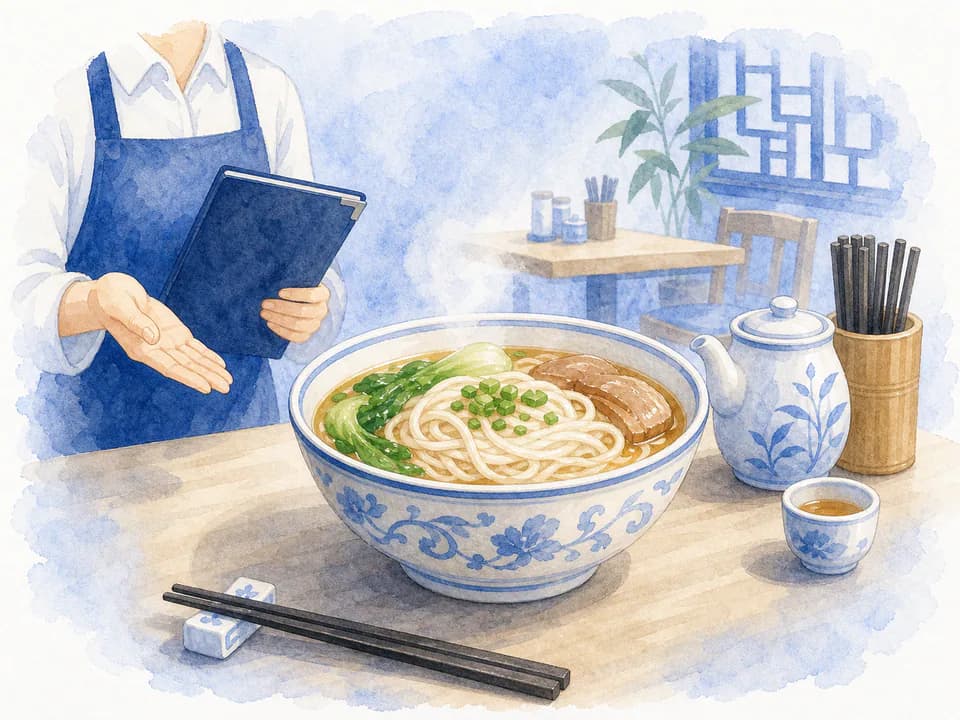
You are ordering food in a small restaurant. The focus is choosing foods and drinks with short polite exchanges.
Contains 4 words
noodles
bread
steamed bun
dumpling
Contains 4 words
Contains 5 words
Contains 5 words
服务员,你好。
Fúwùyuán, nǐ hǎo.
Hello, server.
你想吃什么?
Nǐ xiǎng chī shénme?
What would you like to eat?
我想吃面条儿和包子。
Wǒ xiǎng chī miàntiáor hé bāozi.
I would like noodles and steamed buns.
还要一杯茶。
Hái yào yì bēi chá.
I also want a cup of tea.
你要面包吗?
Nǐ yào miànbāo ma?
Do you want bread?
Situation: A customer orders food and a drink.
美美
Meimei
服务员,你好。
Hello, server.
Modal verbs
Use 想 (xiǎng) + action for what you would like to do, 要 (yào) for a direct selection, and 想要 (xiǎng yào) + item for a less abrupt ‘would like’ item request.
Want to do an action
Says what action someone would like to do.
egg
dish
fruit
apple
to want; to think
to want; to need
do not want
server; attendant
cup; measure word for drinks
also; too
all; both
still; also; in addition
and
to like
不要,我想吃饺子。
Bú yào, wǒ xiǎng chī jiǎozi.
No, I want to eat dumplings.
饺子和鸡蛋都要。
Jiǎozi hé jīdàn dōu yào.
We want both dumplings and eggs.
你喜欢中国菜吗?
Nǐ xǐhuan Zhōngguó cài ma?
Do you like Chinese food?
喜欢,我也要苹果。
Xǐhuan, wǒ yě yào píngguǒ.
Yes, I like it. I also want an apple.
你要水果吗?
Nǐ yào shuǐguǒ ma?
Do you want fruit?
服务员
Server
你好,你想吃什么?
Hello, what would you like to eat?
美美
Meimei
我想吃面条儿和包子,还要一杯茶。
I would like to eat noodles and steamed buns, and I also want a cup of tea.
服务员
Server
好,面条儿、包子和茶。
Okay: noodles, steamed buns, and tea.
Situation: Two classmates choose food together.
美美
Meimei
你要面包吗?
Do you want bread?
方方
Fangfang
不要,我想吃饺子。
No, I want to eat dumplings.
美美
Meimei
还要鸡蛋吗?
Do you also want eggs?
方方
Fangfang
要,饺子和鸡蛋都要。
Yes, we want both dumplings and eggs.
Situation: Two classmates choose Chinese food and match a fruit choice for the order.
美美
Meimei
你喜欢中国菜吗?
Do you like Chinese food?
方方
Fangfang
喜欢,我想吃中国菜。
Yes, I like it. I want to eat Chinese food.
美美
Meimei
我还要苹果。你要水果吗?
I also want an apple. Do you want fruit?
方方
Fangfang
要,我也要苹果。
Yes, I also want an apple.
Situation: A customer adds fruit and water to a simple food order, and the server confirms everything.
方方
Fangfang
服务员,我想要面包和鸡蛋。
Server, I would like bread and eggs.
服务员
Server
好,还要水果吗?
Okay, do you also want fruit?
方方
Fangfang
要,我也要苹果和一杯水。
Yes, I also want an apple and a cup of water.
服务员
Server
好,面包、鸡蛋、苹果和水都要。
Okay: bread, eggs, apple, and water all included.
In this lesson, use this frame to say what eating action you would like to do.
Want an item
Chooses an item directly.
Use this for a direct selection, such as choosing an apple.
Say which item you would like
Presents an item as what the speaker would like, less abruptly than a bare direct selection.
Compare the same item: 我要苹果 (wǒ yào píngguǒ) is direct; 我想要苹果 (wǒ xiǎng yào píngguǒ) is a less abrupt would-like choice.
Use 想 (xiǎng) before the eating action.
我想吃面条儿和包子。
I would like noodles and steamed buns.
Use 要 (yào) before the item you choose.
我要苹果。
I want an apple.
The item stays the same as in 我要苹果 (wǒ yào píngguǒ); 想要 (xiǎng yào) makes this a would-like choice rather than the lesson's most direct selection.
我想要苹果。
I would like an apple.
要,我也要苹果。
Yes, I also want an apple.
我想要苹果。
I would like an apple.
服务员,我想要面包和鸡蛋。
Server, I would like bread and eggs.
Dialogue 01: Ordering Noodles, Turn 3
Order with want to eat
我想吃面条儿和包子,还要一杯茶。
I would like to eat noodles and steamed buns, and I also want a cup of tea.
Dialogue 02: Choosing Dumplings, Turn 2
Refuse and choose another food
不要,我想吃饺子。
No, I want to eat dumplings.
Dialogue 03: Matching Fruit Choices, Turn 4
Match another person's choice
要,我也要苹果。
Yes, I also want an apple.
Dialogue 04: Adding Water to the Order, Turn 1
Say which foods you would like
服务员,我想要面包和鸡蛋。
Server, I would like bread and eggs.
In this lesson, choose 想 (xiǎng) before an action when you describe what you would like to do: 我想吃面条儿 (wǒ xiǎng chī miàntiáor), ‘I would like to eat noodles.’ Use 要 (yào) to make a direct choice: 我要苹果 (wǒ yào píngguǒ), ‘I want an apple.’ Use 想要 (xiǎng yào) before an item when you want to present that item as what you would like: 我想要苹果 (wǒ xiǎng yào píngguǒ), ‘I would like an apple.’
The item can stay the same while the tone changes. 我要苹果 (wǒ yào píngguǒ) is the more direct selection; 我想要苹果 (wǒ xiǎng yào píngguǒ) presents the same apple as something you would like. 想 (xiǎng) is not universally limited to actions, and 要 (yào) is not universally limited to things; these three frames are the practical ordering choices modeled in this Level 1 lesson. Use 不要 (bú yào) to refuse an offered item.
Core adverbs
Use 也 (yě) for "also," 都 (dōu) for "both/all," and 还 (hái) when adding one more item.
Also want the same item
Matches another person's choice.
Put 也 (yě) before the want or action word.
Both linked items
Says the whole linked set is included.
Use 都 (dōu) after the linked foods and before 要 (yào).
Put 也 (yě) before 要 (yào) to match another person's choice.
我也要苹果。
I also want an apple.
Use 都 (dōu) after the linked foods to include both.
饺子和鸡蛋都要。
We want both dumplings and eggs.
还要鸡蛋吗?
Do you also want eggs?
Dialogue 01: Ordering Noodles, Turn 3
Add one more item
我想吃面条儿和包子,还要一杯茶。
I would like to eat noodles and steamed buns, and I also want a cup of tea.
Dialogue 02: Choosing Dumplings, Turn 4
Include both foods
要,饺子和鸡蛋都要。
Yes, we want both dumplings and eggs.
These words come before the want or action word in short Level 1 sentences. Use 也 (yě) when your choice matches another choice, 都 (dōu) when a linked set is included together, and 还 (hái) when you add another food or drink to an order.
Connecting nouns with 和
Use 和 (hé) between two nouns to mean "and."
Link two food nouns
Combines two food choices in one phrase.
Use 和 (hé) between nouns, such as two foods in an order.
和 (hé) links the two food nouns.
面条儿和包子
noodles and steamed buns
Use the same pattern for another linked food pair.
饺子和鸡蛋
dumplings and eggs
面条儿和包子
noodles and steamed buns
饺子和鸡蛋
dumplings and eggs
Dialogue 01: Ordering Noodles, Turn 3
Link foods in the order
我想吃面条儿和包子,还要一杯茶。
I would like to eat noodles and steamed buns, and I also want a cup of tea.
Dialogue 02: Choosing Dumplings, Turn 4
Link foods before both
要,饺子和鸡蛋都要。
Yes, we want both dumplings and eggs.
In this lesson, 和 (hé) links food words inside an order, such as 面条儿和包子 (miàntiáor hé bāozi) or 饺子和鸡蛋 (jiǎozi hé jīdàn). It links nouns here, not whole actions.
都 (dōu) shows that both linked foods are included.
Focus
Dialogue 03: Matching Fruit Choices, Turn 4
Also want the apple
要,我也要苹果。
Yes, I also want an apple.
Focus
