Level 1 - Lesson 17
In this lesson, you shop for clothes and fruit. You ask prices, answer with everyday money words, use larger numbers, and talk about clothing items and fruit by weight.
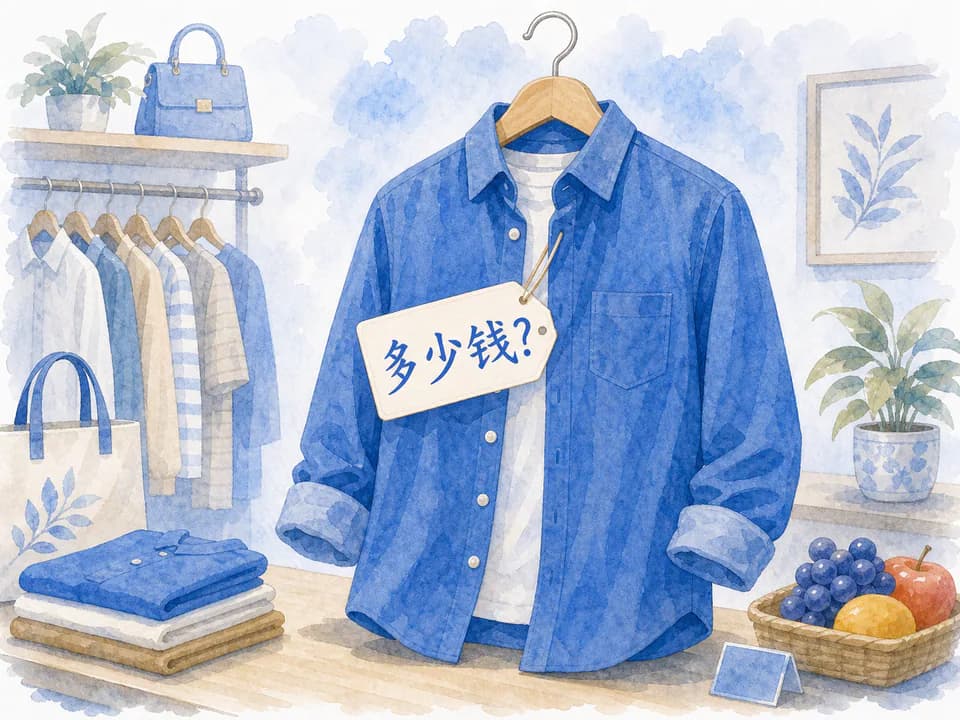
Contains 5 words
money
yuan
colloquial yuan
hundred
thousand
Contains 3 words
Contains 4 words
Contains 3 words
多少钱
Duōshao qián
How much?
这件衣服多少钱
Zhè jiàn yīfu duōshao qián
How much is this piece of clothing?
一千元
Yì qiān yuán
One thousand yuan.
一百块
Yì bǎi kuài
One hundred kuai.
太贵了
Tài guì le
Too expensive.
Situation: In a clothing shop, a customer asks the price of one piece of clothing, asks for a lower price, and decides to buy it.
买衣服的人
Customer
请问,这件衣服多少钱?
Excuse me, how much is this piece of clothing?
Money and price expressions
Use 多少钱 (duōshao qián) after an item or measure to ask the price. In answers, choose one money ending: 块钱 (kuài qián), 块 (kuài), or 元 (yuán).
Ask an item's price
Asks how much one item costs.
cheap
expensive
correct; right
buy
sell
shop assistant
jin; half-kilogram measure
clothes
wear
measure word for clothes
很便宜
Hěn piányi
Very cheap.
商店卖衣服
Shāngdiàn mài yīfu
The store sells clothes.
我买衣服
Wǒ mǎi yīfu
I buy clothes.
我要买这件
Wǒ yào mǎi zhè jiàn
I want to buy this one.
好的
Hǎo de
Okay.
对
Duì
Right / Correct.
这件衣服
Zhè jiàn yīfu
This piece of clothing.
售货员
Shop assistant
一百块钱。
One hundred kuai.
买衣服的人
Customer
太贵了。八十元,我买这件,可以吗?
That is too expensive. Eighty yuan, and I will buy this one. Is that okay?
售货员
Shop assistant
可以,八十元。
Okay, eighty yuan.
Situation: At a fruit stand, a customer asks the price of apples by weight and buys one jin.
买水果的人
Customer
请问,苹果多少钱一斤?
How much are apples per jin?
卖苹果的人
Apple seller
十块钱一斤。
Ten kuai per jin.
买水果的人
Customer
好,我买一斤。
Okay, I will buy one jin.
卖苹果的人
Apple seller
好,一斤十块钱。
Okay, one jin is ten kuai.
Situation: In a clothing shop, two friends compare an expensive piece of clothing with a cheaper one and decide what to buy.
朋友一
Friend 1
这件衣服一千元。
This piece of clothing is one thousand yuan.
朋友二
Friend 2
一千元?太贵了。
One thousand yuan? That is too expensive.
朋友一
Friend 1
那件一百块,很便宜。
That one is one hundred kuai. It is cheap.
朋友二
Friend 2
好,我买那件。
Okay, I will buy that one.
Situation: A customer asks whether one piece of clothing is for sale, hears the price, and buys it.
买衣服的人
Customer
这件衣服卖吗?
Is this piece of clothing for sale?
售货员
Shop assistant
卖,一百块钱。
Yes, for one hundred kuai.
买衣服的人
Customer
好,我买这件。
Okay, I will buy this one.
售货员
Shop assistant
好,一百块钱。
Okay, one hundred kuai.
这件衣服多少钱 (zhè jiàn yīfu duōshao qián) asks the price of one clothing item.
State a price
Answers with a number and money word.
一百块钱 (yì bǎi kuài qián) is a spoken price answer.
State a unit price
Gives the price for one unit of weight.
十块钱一斤 (shí kuài qián yì jīn) means ten kuai for one jin.
Place 多少钱 (duōshao qián) after the item.
这件衣服多少钱?
How much is this piece of clothing?
The money word follows the whole number.
一百块钱
one hundred kuai
元 (yuán) comes after the number.
八十元
eighty yuan
The unit comes after the price.
十块钱一斤
ten kuai per jin
一百块钱。
One hundred kuai.
十块钱一斤。
Ten kuai per jin.
八十元可以。
Eighty yuan is okay.
Dialogue 01: Buying Clothes at the Shop, Turn 1
Buying Clothes at the Shop, customer asks the price
请问,这件衣服多少钱?
Excuse me, how much is this piece of clothing?
Dialogue 01: Buying Clothes at the Shop, Turn 2
Buying Clothes at the Shop, assistant states the first price
一百块钱。
One hundred kuai.
Dialogue 01: Buying Clothes at the Shop, Turn 3
Buying Clothes at the Shop, customer suggests a lower price
太贵了。八十元,我买这件,可以吗?
That is too expensive. Eighty yuan, and I will buy this one. Is that okay?
Dialogue 02: Buying Fruit by Weight, Turn 1
Buying Fruit by Weight, customer asks a unit price
请问,苹果多少钱一斤?
How much are apples per jin?
Dialogue 02: Buying Fruit by Weight, Turn 2
Buying Fruit by Weight, seller states the unit price
十块钱一斤。
Ten kuai per jin.
Use 多少钱 (duōshao qián) when you want to know how much something costs. First name or point to the item, then add 多少钱 (duōshao qián). To answer, put the number before the money word: 一百块钱 (yì bǎi kuài qián), 八十元 (bāshí yuán), or 十块钱一斤 (shí kuài qián yì jīn). 块钱 (kuài qián) is common in everyday speech; 元 (yuán) is the standard currency word. In short model answers for this lesson, use 元 (yuán) by itself rather than adding 钱 (qián) after it.
Number building to 1000
Build 10–19 with 十 (shí) first, 20–99 with a digit before 十 (shí), and exact 100 or 1000 with 一百 (yì bǎi) or 一千 (yì qiān). Put the money word after the complete number.
Build 10 through 19
Starts with ten and adds a ones digit when needed.
十一 (shíyī) is 11: 十 (shí) plus 一 (yī).
Build the other tens
Uses a tens digit, 十 (shí), and an optional ones digit.
三十三 (sānshísān) is 33. 八十 (bāshí) is 80, so it has no final ones digit.
Use the exact hundred or thousand
Builds the exact values 100 and 1000 before adding a money word.
一千元 (yì qiān yuán) builds 1000 first, then adds 元 (yuán).
十一 (shíyī) is 十 (shí) plus the ones digit 一 (yī).
十一块
eleven kuai
二十一 (èrshíyī) is 二 (èr) tens plus 一 (yī).
二十一块
twenty-one kuai
三十三 (sānshísān) uses 三 (sān) before and after 十 (shí): three tens and three ones.
三十三块
thirty-three kuai
一百块钱。
One hundred kuai.
这件衣服一千元。
This piece of clothing is one thousand yuan.
那件一百块,很便宜。
That one is one hundred kuai. It is cheap.
四十五块。
Forty-five kuai.
Dialogue 01: Buying Clothes at the Shop, Turn 2
Buying Clothes at the Shop, assistant states the first price
一百块钱。
One hundred kuai.
Dialogue 03: Choosing the Cheaper Piece, Turn 1
Choosing the Cheaper Piece, friend states the expensive price
这件衣服一千元。
Start with the tens. 十 (shí) is 10, and 十一 (shíyī) is 11: for 10–19, say 十 (shí) and then the ones digit when there is one. For 20–99, put the tens digit before 十 (shí), then add the ones digit when needed: 二十一 (èrshíyī), ‘21,’ 三十三 (sānshísān), ‘33,’ and 八十 (bāshí), ‘80.’ This lets you transfer the pattern to a new amount such as 四十五 (sìshíwǔ), ‘45.’
For the exact larger values taught here, use 一百 (yì bǎi), ‘100,’ and 一千 (yì qiān), ‘1000.’ Then add the money word after the whole amount: 三十三块 (sānshísān kuài), 八十元 (bāshí yuán), 一百块 (yì bǎi kuài), or 一千元 (yì qiān yuán). Other three-digit combinations come later.
八十 (bāshí) is eight tens, with no ones digit after 十 (shí).
八十元
eighty yuan
百 (bǎi) marks the hundred place.
一百块
one hundred kuai
块钱 (kuài qián) comes after the full hundred amount.
一百块钱
one hundred kuai
千 (qiān) marks the thousand place.
一千元
one thousand yuan
This piece of clothing is one thousand yuan.
Dialogue 03: Choosing the Cheaper Piece, Turn 3
Choosing the Cheaper Piece, friend gives the cheaper price
那件一百块,很便宜。
That one is one hundred kuai. It is cheap.
