Level 1 - Lesson 3
You point out teachers, classmates, and friends in a simple school setting. The lesson keeps the focus on short, useful introductions.
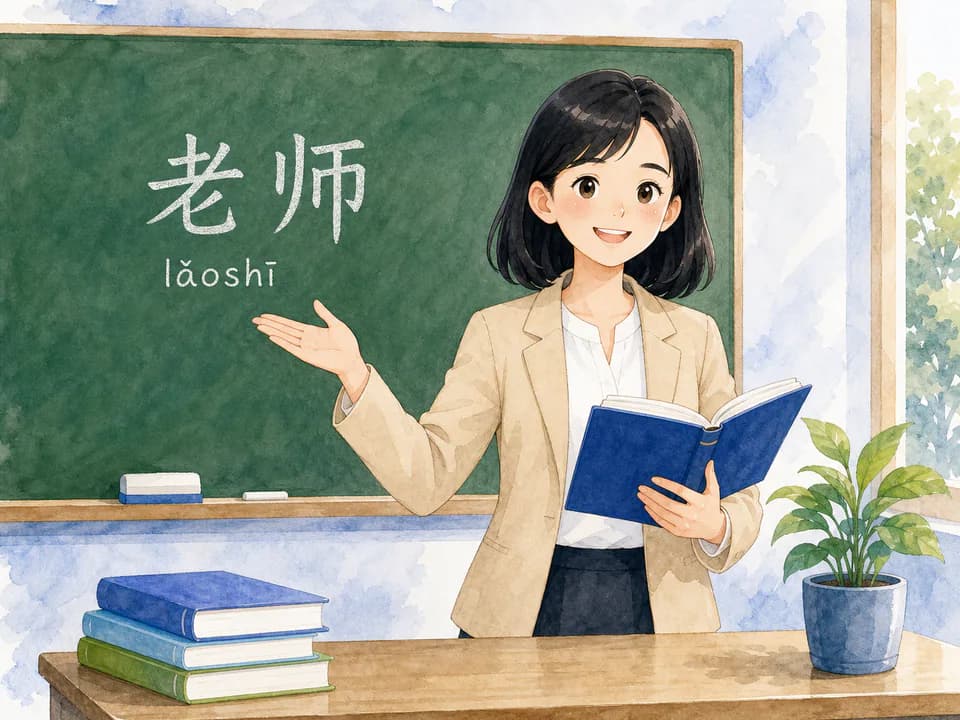
Contains 3 words
he; him
she; her
who
Contains 4 words
Contains 4 words
Contains 2 words
她是老师。
Tā shì lǎoshī.
She is a teacher.
他是我的同学。
Tā shì wǒ de tóngxué.
He is my classmate.
她是我的朋友。
Tā shì wǒ de péngyou.
She is my friend.
他是男老师。
Tā shì nán lǎoshī.
He is a male teacher.
她是女同学。
Tā shì nǚ tóngxué.
She is a female classmate.
Situation: Before class, a student points to the teacher at the front of the room and asks who she is.
美美
Meimei
她是谁?
Who is she?
Possession/modification with 的
Use 的 (de) between a person and a relationship noun: 我的老师 (wǒ de lǎoshī).
Person plus 的 (de) plus relationship
Shows who a teacher, classmate, or friend is connected to.
teacher
classmate
friend
Teacher Wang
male
female
Mr.; sir
Ms.; madam
possessive particle
Chinese language
先生,你好!
Xiānsheng, nǐ hǎo!
Hello, sir!
女士,你好!
Nǚshì, nǐ hǎo!
Hello, madam!
她是谁?
Tā shì shéi?
Who is she?
他是谁?
Tā shì shéi?
Who is he?
她是我的汉语老师。
Tā shì wǒ de Hànyǔ lǎoshī.
She is my Chinese teacher.
他是你的老师吗?
Tā shì nǐ de lǎoshī ma?
Is he your teacher?
是,他是我的老师。
Shì, tā shì wǒ de lǎoshī.
Yes, he is my teacher.
方方
Fangfang
她是王老师。
She is Teacher Wang.
美美
Meimei
王老师是你的汉语老师吗?
Is Teacher Wang your Chinese teacher?
方方
Fangfang
是,她是我的汉语老师。
Yes, she is my Chinese teacher.
Situation: Before class, Meimei asks Fangfang about a man in the classroom.
美美
Meimei
他是谁?
Who is he?
方方
Fangfang
他是我的同学。
He is my classmate.
美美
Meimei
他是你的朋友吗?
Is he your friend?
方方
Fangfang
是,他是我的朋友。
Yes, he is my friend.
Situation: A student at the classroom door first mistakes a classmate for Teacher Wang, then asks who she is.
美美
Meimei
你好,你是王老师吗?
Hello, are you Teacher Wang?
方方
Fangfang
不是,我是方方。
No, I am Fangfang.
美美
Meimei
你是我的同学吗?
Are you my classmate?
方方
Fangfang
是,我是你的同学。
Yes, I am your classmate.
Situation: At the school door, a student asks an adult man about the woman beside him.
美美
Meimei
先生,她是你的朋友吗?
Sir, is she your friend?
先生
Sir
不是,她是王老师。
No, she is Teacher Wang.
美美
Meimei
她是汉语老师吗?
Is she a Chinese teacher?
先生
Sir
是,她是汉语老师。
Yes, she is a Chinese teacher.
我的老师 (wǒ de lǎoshī) means my teacher. Change the first part to 你 (nǐ) for your teacher.
The first word names the connected person; 的 (de) marks the connection.
我的老师
my teacher
你 + 的 (nǐ + de) marks whose teacher; 汉语 + 老师 (Hànyǔ + lǎoshī) says what kind of teacher.
你的汉语老师
your Chinese teacher
她是我的汉语老师。
She is my Chinese teacher.
他是我的同学。
He is my classmate.
Dialogue 01: Teacher Wang, Turn 3
Ask about your teacher
王老师是你的汉语老师吗?
Is Teacher Wang your Chinese teacher?
Dialogue 02: Identifying a Classmate, Turn 4
Confirm my friend
他是我的朋友。
He is my friend.
Use 的 (de) after a person or pronoun to connect that person to a relationship noun. In 我的老师 (wǒ de lǎoshī), 我 (wǒ) names the connected person, 的 (de) marks the connection, and 老师 (lǎoshī) names the relationship.
Do not use 的 (de) inside the short role labels taught in this lesson. 汉语老师 (Hànyǔ lǎoshī) means “Chinese-language teacher,” with 汉语 (Hànyǔ) directly describing 老师 (lǎoshī). To say “my Chinese teacher,” put the two layers together: 我 (wǒ) + 的 (de) + 汉语 (Hànyǔ) + 老师 (lǎoshī) → 我的汉语老师 (wǒ de Hànyǔ lǎoshī). Use person + 的 (de) for the connection; use the bare descriptor + noun pattern for the kind of role.
Ask person identity with 谁
Use 谁 (shéi) where the person answer would go.
Ask who someone is
Asks for the person's identity.
谁 (shéi) stays where the person answer would go.
Use 她 (tā) for a woman or girl in writing.
她是谁?
Who is she?
Use 他 (tā) for a man or boy in writing.
他是谁?
Who is he?
谁 (shéi) takes the person position because the person with the role is unknown.
谁是汉语老师?
Who is the Chinese teacher?
她是谁?
Who is she?
他是谁?
Who is he?
Dialogue 01: Teacher Wang, Turn 1
Ask who she is
她是谁?
Who is she?
The previous lesson used 什么 (shénme) to ask for a name or thing. This lesson extends that question-word system with 谁 (shéi), which asks for a person. In 她是谁? (Tā shì shéi?), the person answer after 是 (shì) is unknown, so 谁 (shéi) goes in that answer position.
Keep the normal sentence order: person first, then 是 (shì), then 谁 (shéi). Do not move 谁 (shéi) to the front. You can also put 谁 (shéi) in the person position when that is the unknown part: 谁是汉语老师? (Shéi shì Hànyǔ lǎoshī?), “Who is the Chinese teacher?”
Bare role descriptors before nouns
In the short role labels taught here, put 男 (nán), 女 (nǚ), or 汉语 (Hànyǔ) directly before the person noun without 的 (de): 女同学 (nǚ tóngxué).
Description before noun
Names what kind of classmate or teacher without adding 的 (de).
Put the descriptor before the noun without 的 (de): 女同学 (nǚ tóngxué), 汉语老师 (Hànyǔ lǎoshī).
女 (nǚ) describes 同学 (tóngxué) directly; do not add 的 (de) in this role label.
女同学
female classmate
汉语 (Hànyǔ) describes 老师 (lǎoshī) directly; do not add 的 (de) in this role label.
汉语老师
Chinese teacher
她是女同学。
She is a female classmate.
她是我的汉语老师。
She is my Chinese teacher.
Dialogue 01: Teacher Wang, Turn 3
Ask about a Chinese-language teacher
王老师是你的汉语老师吗?
Is Teacher Wang your Chinese teacher?
In the short role labels taught in this lesson, put the descriptor directly before the person noun: 女同学 (nǚ tóngxué), “female classmate,” and 汉语老师 (Hànyǔ lǎoshī), “Chinese-language teacher.” Do not insert 的 (de) between these parts.
This is different from the person-connection pattern. 汉语老师 (Hànyǔ lǎoshī) says what kind of teacher; 我的老师 (wǒ de lǎoshī) says whose teacher. The combined phrase 我的汉语老师 (wǒ de Hànyǔ lǎoshī) has both layers: 我 (wǒ) + 的 (de) marks the connection, while 汉语 (Hànyǔ) + 老师 (lǎoshī) forms the role label without another 的 (de). This is the bounded choice for the role words in this lesson, not a rule for every possible Chinese modifier.
